Table of contents
Buying a home involves more than making a down payment. Buyers may also need money for lender fees, title charges, prepaid taxes, homeowners insurance, and other closing expenses. A seller concession can help reduce those upfront costs.
However, seller concessions are not unlimited. The amount a seller may contribute depends on the mortgage program, property type, down payment, and the buyer’s actual eligible expenses.
What Is a Seller Concession?
A seller concession is a negotiated credit that the seller provides toward eligible expenses normally paid by the buyer. The credit is included in the purchase agreement and appears on the final closing documents.
The maximum permitted percentage is only a ceiling. The seller must agree to the credit, and the buyer must have enough eligible expenses to use it.
Seller concessions generally cannot:
- Replace the buyer’s required down payment
- Create cash back for the buyer
- Exceed the buyer’s actual eligible costs
- Be used for expenses prohibited by the mortgage program
What Can Seller Concessions Cover?
Depending on the loan program, seller concessions may cover:
- Lender, title, settlement, recording, and appraisal charges
- Prepaid property taxes and homeowners insurance
- Initial escrow deposits
- Discount points
- Temporary or permanent interest-rate buydowns
- Certain mortgage insurance or funding fees
- Other program-approved closing expenses
Some programs have special rules. For example, VA loans may allow certain debts or obligations to be paid through the separate seller-concession allowance.
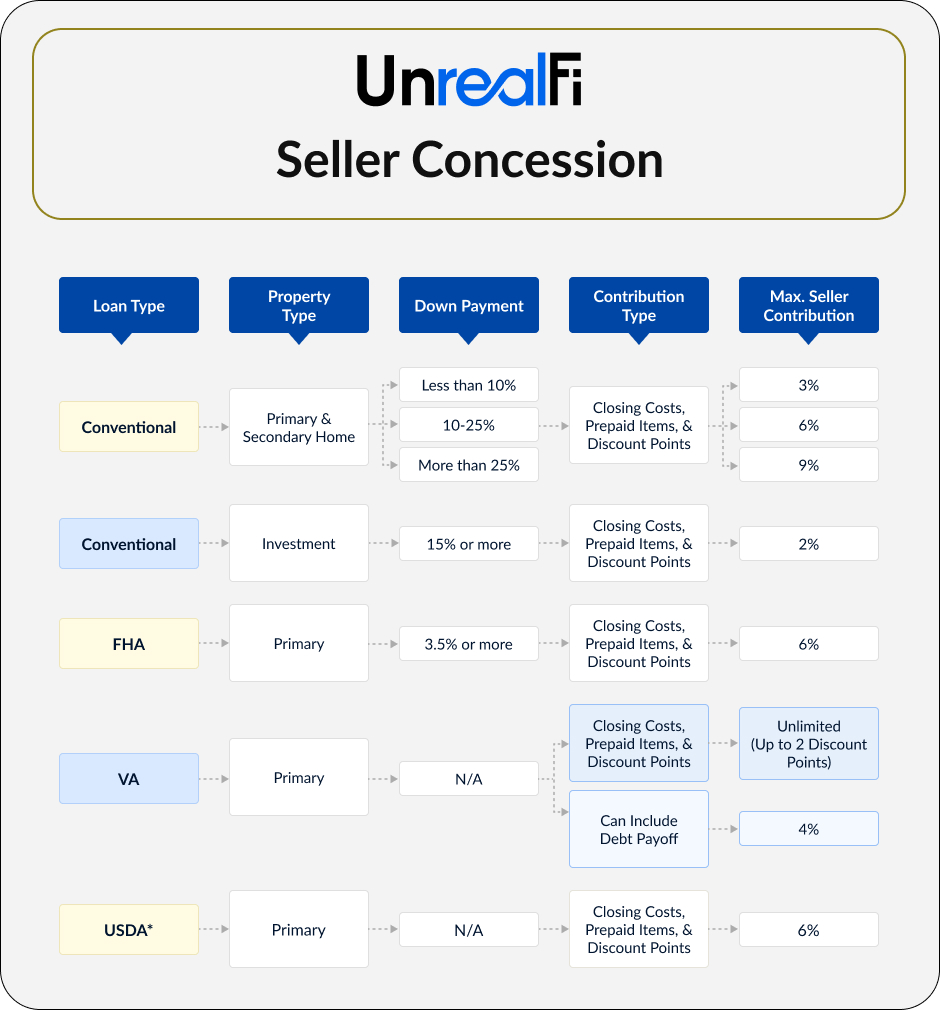
Seller-concession limits vary by loan program, property type, and down payment. Always confirm the final allowable amount with the lender handling the transaction.
How Much Can a Seller Contribute?
Conventional Loans
For a conventional loan on a primary residence or second home, the maximum seller contribution generally depends on the loan-to-value ratio, which is closely related to the buyer’s down payment:
- Less than 10% down: up to 3%
- At least 10% but less than 25% down: up to 6%
- 25% down or more: up to 9%
- Investment property: up to 2%, regardless of the eligible down payment
The contribution is generally calculated using the lower of the sales price or appraised value. It also cannot exceed the buyer’s actual eligible closing costs.
The exact 25% boundary is important: current Fannie Mae and Freddie Mac guidance places a loan with 25% down, or 75% loan-to-value, in the 9% tier. Fannie Mae guidance.
FHA Loans
For a typical FHA purchase loan, interested parties may contribute up to 6% of the sales price toward eligible expenses. These may include origination fees, closing costs, prepaid items, discount points, and approved interest-rate buydowns.
The credit cannot be used to provide the borrower’s minimum required investment, which is generally the 3.5% minimum down payment. Current HUD FHA Handbook
VA Loans
VA loans treat ordinary closing-cost assistance differently from certain seller concessions.
A seller may generally pay the veteran’s allowable closing costs and up to two discount points without those amounts counting against the separate 4% seller-concession cap.
The 4% cap applies to items classified as concessions, which may include:
- Payment of the VA funding fee
- Prepaid property taxes and insurance
- Discount points above the excluded amount
- Gifts or additional benefits
- Payoff of certain credit balances or judgments
Because the classification of each expense matters, buyers should have a VA-experienced loan officer review the requested credit before the offer is submitted. VA Lender’s Handbook.
USDA Guaranteed Loans
USDA guaranteed loans generally permit seller or other interested-party contributions of up to 6% of the sales price.
The money must be applied to an eligible loan purpose. USDA guidance does not allow a seller contribution to pay the applicant’s personal debt or provide prohibited personal-property incentives. USDA HB-1-3555
The Maximum Is Not Always the Usable Amount
A program may permit a certain percentage, but that does not mean the buyer can automatically use the entire amount.
For example, on a $400,000 purchase:
- 3% equals $12,000
- 6% equals $24,000
- 9% equals $36,000
- 2% equals $8,000
If the buyer has only $9,500 in eligible costs, the usable credit may be limited to $9,500—even if the loan program would permit a higher percentage.
The final amount may also be affected by:
- The appraised value
- Changes to the purchase price
- The buyer’s final closing costs
- Investor or lender requirements
- The wording of the purchase agreement
- Underwriting approval
How to Use a Seller Concession Strategically
Reduce Cash Needed at Closing
A credit toward closing costs and prepaid expenses can help the buyer keep more savings available for moving, repairs, furnishings, and emergency reserves.
Consider an Interest-Rate Buydown
The seller credit may be used to purchase discount points or fund an approved temporary buydown. Buyers should ask their loan officer to compare the monthly payment, break-even period, and long-term cost with those of a price reduction.
Match the Request to the Buyer’s Costs
The requested concession should be based on a current loan estimate or fee worksheet. Asking for more than the buyer can use may result in part of the credit being lost or require a last-minute contract amendment.
Consider the Appraisal
A higher purchase price paired with a large seller credit still needs appraisal support. The concession should be evaluated together with the price—not treated as free money.
Before Submitting the Offer
Before requesting a seller concession, the buyer and real estate agent should:
- Confirm the loan program and property type
- Verify the planned down payment or loan-to-value ratio
- Ask the loan officer for the maximum permitted contribution
- Estimate how much of the credit the buyer can actually use
- Decide whether the credit should prioritize closing costs, prepaid expenses, or a rate buydown
- Include a clear dollar amount or “up to” amount in the contract
- Recheck the credit after the appraisal and before closing
The Bottom Line
Seller concessions can make buying a home more affordable by reducing the cash required at closing. However, the advertised percentage is only the starting point.
The most effective concession is one that fits the mortgage program, matches the buyer’s actual expenses, is supported by the appraisal, and is reviewed by the lender before the offer is finalized.
To compare your options, ask your loan officer for estimates showing your cash to close with no concession, with a closing-cost credit, and with an interest-rate buydown.
For assistance, contact Or Gera, Senior Loan Officer, NMLS ID 1269459, at 224-489-8260 or or@unrealfi.com.
This article is for general informational purposes only. It is not legal, tax, financial, or lending advice or a commitment to lend. Mortgage guidelines and lender requirements may change. All loans are subject to credit approval. Equal Housing Opportunity.